
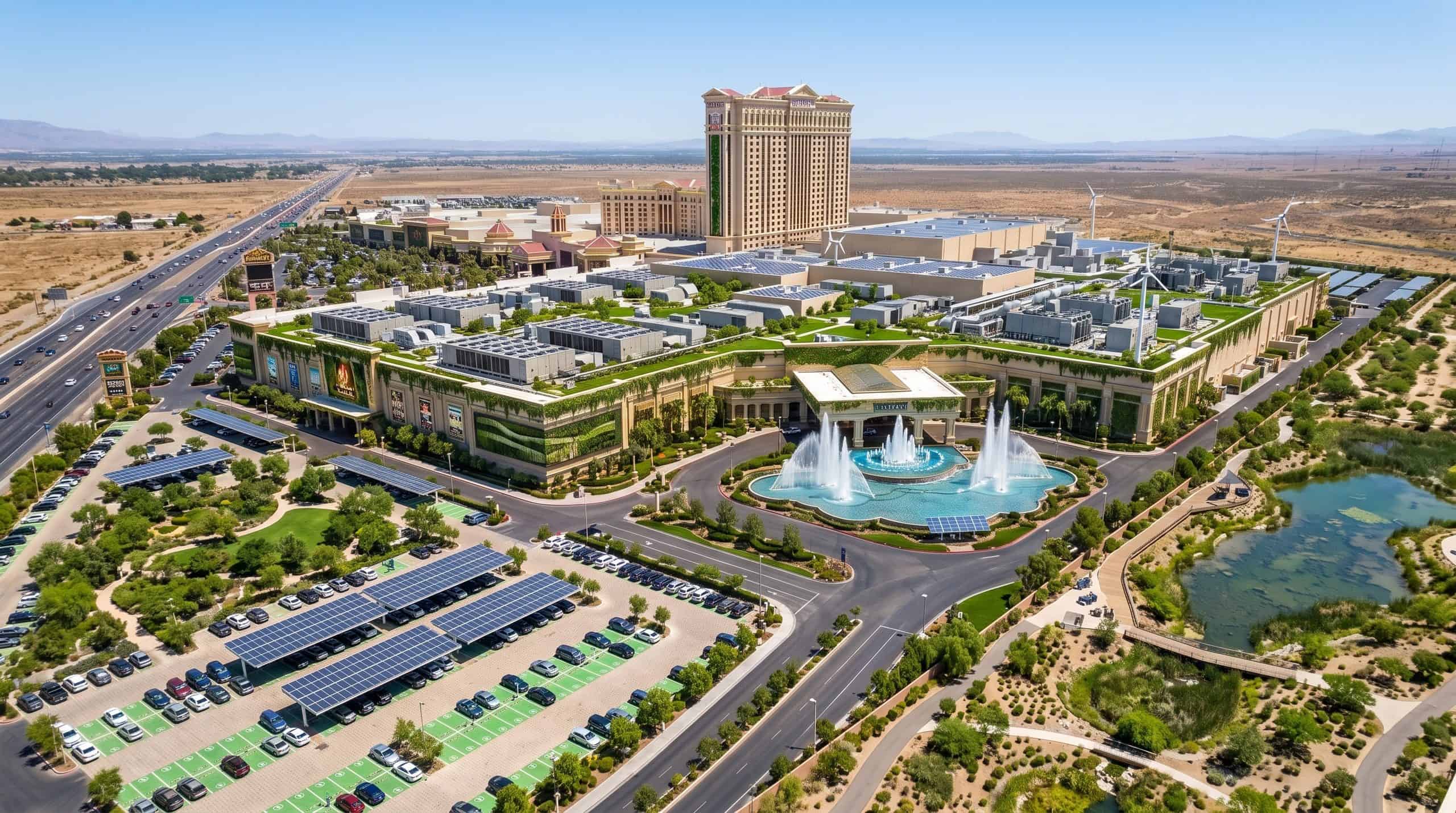
When people talk about casinos going green, the story usually starts in Las Vegas: rooftop solar, LED lighting, recycling programmes behind the scenes. It’s a fair place to start, because large resorts that run around the clock use a lot of energy for lighting, heating and cooling. But it only covers half of the industry. A growing share of gambling now happens on phones and laptops, and there the energy question looks completely different.
Speedz Casino is an example of a fully online operator. There is no casino floor to light, heat or cool, so the energy question moves elsewhere: to the servers that run the games, the networks that carry them and the devices players use. That doesn’t make the footprint zero. It makes it harder to see.
What land-based resorts are doing
The most visible measures are the big ones. On the roof of the Mandalay Bay convention centre in Las Vegas, an array of 26,000 solar panels spread over 28 acres, completed in 2016 and billed at the time as the largest rooftop installation in the United States, covers roughly a quarter of the centre’s energy use. Smaller steps follow the same logic: LED lighting, more efficient heating and cooling, recycling programmes and linen-reuse schemes for hotel guests. Many of these cut costs as well as emissions, which helps explain why they have spread so widely.
The online footprint lives in data centres

For online play, the main energy use sits in data centres. The International Energy Agency estimates that data centres used about 415 TWh of electricity in 2024, around 1.5% of global consumption, and expects that to more than double to roughly 945 TWh by 2030, slightly more than Japan’s entire electricity consumption today. Context matters, though: the same analysis puts data centres at around one-tenth of global electricity demand growth to 2030, less than industrial motors, air conditioning or electric vehicles.
Gambling is a small slice of that. Casino-specific figures are hard to isolate, because many online operators rent capacity from large cloud providers rather than running their own server halls. What can be said is which choices tend to matter most:
- Where the servers are. The same server emits far less on a low-carbon grid than on a coal-heavy one.
- How efficient the facility is. Modern, well-run data centres waste less energy on cooling and overhead than older in-house server rooms.
- How much data a game moves. Lean pages and efficient caching mean less data to transmit. Live dealer tables, which stream video continuously, move far more data than a slot.
- What happens on the player’s side. Devices and home or mobile networks use energy too, and that sits outside any operator’s control.
Treat “green” claims with care
Whether a casino is online or bricks-and-mortar, vague claims such as “eco-friendly” deserve scepticism. EU rules that apply from 27 September 2026 restrict generic environmental claims that aren’t backed by recognised environmental performance, and they also target “neutral” climate claims that rest on offsetting. For readers, the useful questions are specific ones: what share of the electricity is renewable, who verified it, and what exactly is being measured.
The bottom line
Online isn’t automatically greener, and land-based isn’t automatically worse. The two models consume energy in different places, which is exactly why a fair comparison needs specifics rather than slogans. Rooftop solar is easy to photograph; a server’s grid mix is not. As the industry continues to move online, the second kind of detail is the one worth asking about.
Gambling is for adults aged 18 and over. Play responsibly.